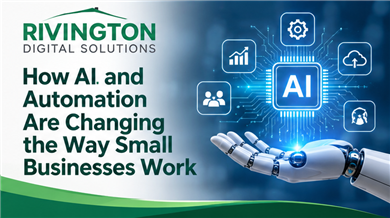
Artificial intelligence and business automation are changing the way companies operate.
What was once considered technology for large organisations with significant IT budgets is now becoming increasingly accessible to small and medium sized businesses.
From automating repetitive administration to improving customer communication, analysing business information and streamlining everyday processes, technology offers opportunities to work more efficiently and competitively.
For many SMEs, the challenge is not whether these technologies are available. It is understanding which ones are genuinely useful and how to introduce them without creating unnecessary complexity.
At Rivington Digital, we believe technology should solve problems, save time and help businesses achieve more.
AI is already having a significant impact on digital marketing.
Businesses can use AI tools to assist with research, analyse information, generate ideas and support content creation.
Search engines are also evolving, with AI powered search experiences changing how people discover information, research products and find businesses.
This creates new opportunities but also means businesses need to think carefully about their online presence.
Useful website content, clear information about products and services, technical performance and a trustworthy online reputation remain important.
AI can assist with content creation and research, but it should not replace genuine industry knowledge or an understanding of your customers.
Businesses that combine useful expertise with the effective use of modern technology will be better placed to adapt.
How much time does your business spend completing tasks that follow the same process every day?
It could be processing enquiries, generating quotations, updating spreadsheets, sending customer notifications or transferring information between different systems.
These activities can consume valuable time that could otherwise be spent looking after customers and growing the business.
Automation allows certain processes to happen automatically when specific conditions are met.
Examples include:
Automatically sending confirmation emails when an enquiry is received.
Generating quotations from customer supplied information.
Sending reminders for appointments or outstanding actions.
Transferring information between connected systems.
Automatically producing reports from business data.
Updating customer records following an online purchase.
The aim is not to remove the human element from your business. It is to reduce unnecessary manual work and allow your team to concentrate on more valuable activities.
Many businesses use several different software packages to manage their operations.
You might use one system for accounting, another for customer management, a separate ecommerce platform and spreadsheets for internal administration.
The problem is that these systems do not always communicate with each other.
This can lead to duplicated information, unnecessary administration and an increased risk of mistakes.
Software integration can help connect different systems so information can be shared more efficiently.
For example, an ecommerce website could connect with your stock management system, allowing product availability to be updated automatically.
A website enquiry form could pass customer information directly into a CRM system, reducing the need for someone to manually enter the details.
Accounting integrations can also help businesses streamline the transfer of invoices, customer information and financial records.
The right integrations can make a significant difference to everyday business operations.
Off the shelf software is useful, but it does not always provide everything a business needs.
Sometimes the most effective solution is to develop something specifically around your processes.
Bespoke software can include:
Online quotation and calculation tools.
Customer portals and account management systems.
Document management platforms.
Custom ecommerce functionality.
Stock and order management solutions.
Automated reporting systems.
Business specific workflow tools.
For example, a company that regularly prepares complex quotations could benefit from an online calculation tool that automatically applies pricing rules and produces a professional quotation.
This can reduce administration, improve consistency and provide customers with a quicker response.
At Rivington Digital, we have experience developing tailored software solutions that connect websites, business processes and existing systems.
One of the biggest misconceptions about digital transformation is that it requires a complete overhaul of your business.
In reality, some of the most valuable improvements can come from making relatively small changes.
Start by identifying the tasks that take up the most time or cause the most frustration.
Consider whether a process could be simplified, automated or connected to another system.
It might be something as straightforward as improving an online enquiry form or introducing an automated email response.
Over time, these improvements can build into a much more efficient way of working.
It is also important to consider security, data protection and staff training when introducing new technologies. Automation and AI should be implemented responsibly, with appropriate human oversight.
Every business is different, which is why we believe technology solutions should be based on your actual requirements rather than simply following the latest trends.
With over 45 years of combined industry experience, Rivington Digital helps businesses explore practical ways to improve their websites, marketing and internal processes.
Whether you are considering a new website, looking to integrate existing software or have an idea for a bespoke business solution, we can help you understand what is possible.
Want to make your business more efficient? Contact Rivington Digital and let's discuss how technology could help your business work smarter.